
Table of Contents
- Why T-Shirts Lose Their Shape
- The Impact of Heat and Tumble Drying on Garment Integrity
- Washing Machine Habits That Cause Distortion
- How to Prevent T-Shirts from Stretching
- How to Shrink a Stretched T-Shirt Back to Size
- Fabric Quality and Material Composition Matter
- Conclusion
Last Updated: August 15, 2026
Why T-Shirts Lose Their Shape
A t-shirt that fit perfectly on day one shouldn't feel baggy by month three. Yet this happens constantly. The reason isn't mysterious, it's physics, chemistry, and the specific way fabric responds to stress.
T-shirts lose their shape through a combination of mechanical stress, heat exposure, and the natural limitations of how fibers recover after being stretched. Understanding this process helps you make smarter laundry decisions and choose garments built to last.
How Cotton Fibers Stretch Under Stress
Cotton fibers are surprisingly elastic. When you pull a cotton t-shirt, the individual fibers elongate, they don't break. This elasticity is what makes cotton comfortable and wearable. The problem emerges when fibers are stretched repeatedly without adequate time to recover.
Each fiber has a natural resting state. When you wear a t-shirt, body heat, moisture, and movement all cause the fibers to shift slightly. The fabric stretches to accommodate your body. Under normal conditions, fibers snap back to their original position once the stress is removed. But this recovery isn't instantaneous, and it's not always complete.
The key factor is fiber elasticity, the ability of stretched fibers to return to their original length. Cotton fibers have moderate elasticity. They can recover from stretching, but only if they're given enough time between stress events. Continuous wear, repeated washing, and inadequate drying all compromise this recovery window. Over time, the fibers develop a kind of "memory" of their stretched state. They stop bouncing back.
This is why a t-shirt worn daily often stretches faster than one worn occasionally.
The Role of Fabric Recovery
Fabric recovery is the textile's ability to return to its original dimensions after being stretched or compressed. It's not the same as fiber elasticity, though the two are related.
Fabric recovery depends on how the fibers are woven or knitted together. A well-constructed knit has tight loops that hold fibers in alignment. When stretched, these loops can shift slightly but then realign. A poorly constructed knit has loose loops that don't rebound as effectively. Once they shift, they stay shifted.
Recovery also depends on fiber composition. Pure cotton has decent recovery but not exceptional recovery. This is why many quality t-shirts use cotton blends, adding elastane or spandex dramatically improves the fabric's ability to snap back into shape. Even a small percentage of elastane (2-5%) makes a noticeable difference in how well a t-shirt maintains its form.
Temperature matters too. Fibers recover better at cooler temperatures. Heat weakens the molecular bonds that hold fibers in their resting state, making recovery slower and less complete. This is why hot dryers are so damaging, they're literally preventing your fabric from bouncing back.
The Impact of Heat and Tumble Drying on Garment Integrity
Tumble drying is one of the most destructive forces in laundry. The combination of high heat, mechanical agitation, and moisture creates conditions that accelerate shape loss.
Heat breaks down the molecular structure of fibers. At high temperatures, the hydrogen bonds that hold cotton fibers in their resting state weaken. The fibers become more pliable, more prone to stretching, and less capable of recovery. This is why fabrics straight from a hot dryer feel softer but also why they're more vulnerable to permanent distortion.
The mechanical action of tumbling adds another layer of damage. Clothes tumble against each other and the drum. This constant friction and collision creates stress on individual fibers and on the overall fabric structure. The fibers are being stretched, compressed, and twisted simultaneously. Even if the temperature were moderate, this agitation alone causes gradual shape loss.
Moisture amplifies both effects. Wet fibers are more elastic and more prone to permanent deformation. A wet t-shirt tumbling in a hot dryer is essentially being stretched and reshaped while in its most vulnerable state. When it cools and dries, it can lock into that new, often distorted shape.
The combination is especially damaging: high heat reduces fiber recovery capacity, agitation creates constant stress, and moisture makes fibers more deformable. A t-shirt that goes through a hot dryer cycle is being actively reshaped toward a larger, more distorted form.
Washing Machine Habits That Cause Distortion
How you wash your t-shirts matters as much as how you dry them. Several common washing practices accelerate shape loss.
Overloading and Agitation Effects
Overstuffing a washing machine creates two problems: insufficient water circulation and excessive friction between garments.
When a machine is overloaded, water can't flow freely around each piece. Detergent doesn't distribute evenly. Some areas of your t-shirt get more agitation than others, creating uneven stress on the fabric. The fibers in heavily agitated zones experience more mechanical stress and are more likely to stretch permanently.
Additionally, crowded garments rub against each other throughout the wash cycle. This friction creates stress similar to tumble drying, fibers are being stretched and compressed repeatedly. A t-shirt that spends 30 minutes packed tightly against other clothes is experiencing continuous low-level damage.
The spin cycle makes this worse. When the machine spins to remove water, overloaded garments are pressed against each other with significant force. The t-shirt is being twisted and compressed while wet, exactly the conditions that make permanent deformation likely.
Best practice is to fill your machine only 60-70% full. This allows adequate water circulation, even detergent distribution, and minimal friction between pieces.
Water Temperature and Detergent Breakdown
Hot water accelerates the breakdown of fiber structure. While cold water doesn't eliminate all risk, it significantly reduces the heat-related damage that contributes to shape loss.
Detergent chemistry also plays a role. Standard detergents contain surfactants that help break down dirt and oils. These surfactants work by reducing the surface tension of water, allowing it to penetrate fabric more deeply. But this same action can weaken the bonds holding fibers in their resting state. The detergent is essentially softening the fabric, making fibers more pliable and more prone to permanent stretching.
Residual detergent left in the fabric after rinsing compounds this problem. If your rinse cycle isn't thorough, detergent molecules remain in the fibers, continuing to weaken them even after the wash is complete. This is why a final cold rinse is valuable, it helps flush out remaining detergent and allows fibers to begin resetting to their original state while still cool.
How to Prevent T-Shirts from Stretching
Preventing shape loss is far simpler than trying to fix it afterward. The key is reducing mechanical stress, heat exposure, and time spent in vulnerable states.
Proper Washing Techniques
Start with a cold water wash. Cold water preserves fiber structure and slows the breakdown of molecular bonds. It's effective for most everyday stains and significantly reduces the risk of heat-related damage.
Use a gentle or delicate cycle. These cycles reduce agitation intensity and spin speed. Your t-shirt still gets clean, but the fibers experience less mechanical stress. For high-quality t-shirts, a gentle cycle is worth the extra time.
Don't overload the machine. Fill it only 60-70% full. This allows water to circulate freely, reduces friction between garments, and ensures even stress distribution during the spin cycle.
Use less detergent than you think you need. Most people use twice the recommended amount. Excess detergent doesn't clean better, it just leaves residue in the fabric that weakens fibers. Follow the manufacturer's guidelines, or use even slightly less for lightly soiled items.
Add a final cold rinse if your machine allows it. This flushes out remaining detergent and allows fibers to cool and reset to their resting state while still in the machine.
Air Drying vs. Machine Drying
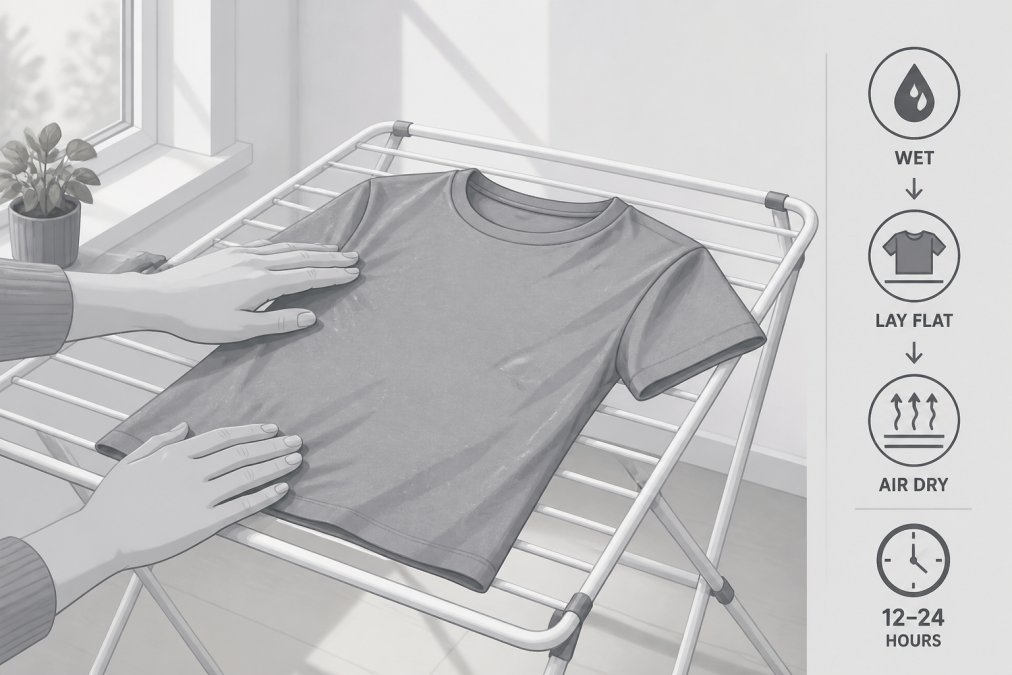
Air drying is the gold standard for preventing shape loss. When a t-shirt dries flat or on a rack without heat or agitation, fibers have time to recover naturally. The fabric returns to its resting state gradually and completely.
The best method is flat drying. Lay your t-shirt on a clean, dry surface, a drying rack, a towel, or even a clean bed. Smooth out wrinkles gently. This allows even drying and prevents the fabric from stretching under its own weight. Flat drying takes longer than machine drying, but the payoff in garment longevity is substantial.
If you must use a dryer, use the lowest heat setting available. Some machines have an "air dry" or "delicate heat" option. These cycles use minimal or no heat, reducing fiber damage while still removing moisture. Avoid high heat entirely.
Never leave a t-shirt in the dryer after the cycle ends. The residual heat continues to weaken fibers and can cause wrinkles that lock in permanent creases and distortion.
How to Shrink a Stretched T-Shirt Back to Size
If a t-shirt has already lost its shape, recovery is possible, but results vary depending on fiber composition.
The most effective method involves controlled heat exposure combined with reshaping. Wash the t-shirt in hot water with a gentle detergent. Hot water makes fibers more pliable and more likely to return to a smaller form. While the t-shirt is still damp, lay it flat and reshape it to the desired size. Smooth out any wrinkles or distortions. Allow it to air dry completely in this reshaped state.
As it dries, the fibers will lock into the new shape. This works best if the t-shirt hasn't been stretched too severely and if it's made from a fiber blend that includes elastane or spandex.
Synthetic Blends vs. 100% Cotton Recovery
A cotton-elastane blend recovers from stretching far more effectively than 100% cotton. Even a small percentage of elastane (2-5%) dramatically improves a fabric's ability to snap back into shape after stretching or heat exposure.
This is because elastane fibers are inherently elastic. They're designed to stretch and recover repeatedly without permanent deformation. When blended with cotton, elastane fibers act as a support structure, helping cotton fibers return to their resting state more quickly and more completely.
A 100% cotton t-shirt can be reshaped using heat and moisture, but the results are often temporary. The fibers lack the inherent elasticity to maintain the new shape indefinitely. Over time, especially with continued wear and washing, the t-shirt will gradually stretch again.
If you're buying new t-shirts and shape retention matters to you, a cotton-elastane blend is the smarter choice. The blend costs slightly more but delivers significantly better longevity.
Fabric Quality and Material Composition Matter
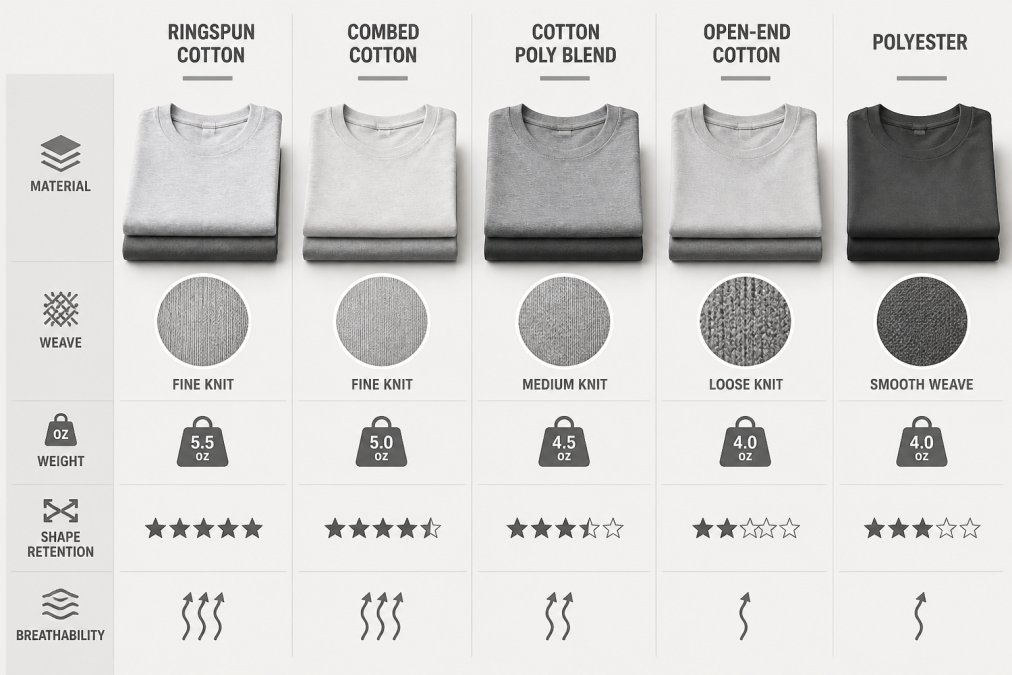
Not all t-shirts are built the same. The quality of the base fabric, the weight, the weave tightness, and the fiber composition, determines how well a t-shirt resists shape loss.
A quality t-shirt uses heavier fabric. Fabric weight is measured in grams per square meter (gsm). Most basic t-shirts range from 130-150 gsm. Quality t-shirts often run 160-200 gsm. Heavier fabric has denser fiber packing, which means tighter knit structure and better shape retention. The fibers don't shift as easily, and the overall garment resists distortion more effectively.
The knit structure also matters. A tight knit with consistent loop formation resists shape loss better than a loose knit. Tight knits hold fibers in alignment more effectively. When stretched, the loops shift slightly but then realign. Loose knits don't rebound as effectively.
Fiber composition is the final factor. As mentioned, a blend with elastane dramatically improves recovery. But even the quality of the base cotton matters. Higher-quality cotton fibers are longer and stronger, which means they recover better from stretching. Lower-quality cotton has shorter fibers that don't rebound as effectively.
POP Inc. provides essential apparel, focusing on high-quality, relaxed t-shirts for everyday comfort and style. Our collection offers versatile unisex and women's relaxed fit options, serving as timeless staples for any wardrobe. We deliver accessible fashion choices that prioritize a comfortable fit and enduring design. Our commitment is to provide straightforward, functional pieces that effortlessly integrate into your daily life.
Shape loss in t-shirts isn't inevitable. It's the result of specific stress factors, heat, agitation, fiber composition, and time. By understanding what causes stretching, you can make smarter choices about how you wash, dry, and store your t-shirts. And when you're choosing which t-shirts to buy in the first place, prioritizing fabric quality and fiber composition means you're starting with garments built to last. Start with better fabric, treat it with care, and your t-shirts will hold their shape for years.
Frequently Asked Questions
Can shrinking be reversed if my t-shirt has already lost its shape?
Partial recovery is possible, especially with synthetic blends that contain elastane or spandex. These fibers have natural elasticity and can regain some shape when exposed to heat or moisture. 100% cotton shirts recover more slowly and may not return to original dimensions. The best approach is to prevent stretching in the first place through proper washing and air drying. Once significant distortion occurs, restoration is limited.
What fabrics are most prone to losing their shape?
100% cotton t-shirts lose shape more easily than blended fabrics because cotton fibers lack inherent elasticity. Lightweight cotton knits stretch faster than heavier-weight constructions. Synthetic blends with elastane or spandex maintain shape better due to fiber recovery properties. Poorly constructed garments with weak seams and loose knit structures deteriorate faster. Higher-quality fabrics with tighter weaves and reinforced construction resist distortion longer.
Does high heat cause t-shirts to stretch or shrink?
High heat primarily causes shrinkage in cotton fibers, but the effect depends on moisture. Tumble drying on high heat can shrink a t-shirt initially, then mechanical stress from agitation and movement causes subsequent stretching. When wet, heat softens cotton fibers, making them more prone to stretching under tension. Air drying eliminates this risk entirely. For best results, wash in cold water and air dry flat to prevent both shrinkage and stretching.
How does water hardness affect whether my t-shirt stretches?
Hard water reduces detergent effectiveness, leaving residue on fibers that weakens their structural integrity. This residue accumulates with each wash, reducing fiber elasticity and tensile strength. Hard water also interferes with proper rinsing, trapping mineral deposits that make fibers more susceptible to stretching under mechanical stress. Using a water softener or chelating detergent designed for hard water helps maintain fabric recovery and prevents premature shape loss in your t-shirts.
This article was written using GrandRanker